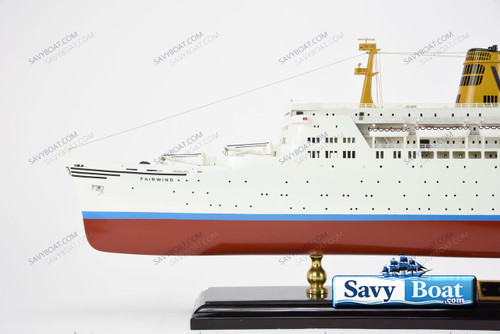


FAIRSEA PASSENGER SHIP
FULLY BUILT AND READY TO DISPLAY MUSEUM QUALITY SHIP MODEL
- Dimension approx.: 40″ (long) x 4.75″ (wide) x 12″ (high)
- LED LIGHTING INSTALLED (power supply not included)
- The model is already built, NOT a model ship kit
- Handcrafted from scratch using finest woods & metal fittings
- BEAUTIFUL MUSEUM QUALITY MODEL
- This beautiful model is already built, NOT a kit.
- Handcrafted from finest wood and metal fittings.
- Open die cut side hull windows, NOT painted like those built by most other companies.
- The model is 100% hand built by artisans from scratch
- Hand-painted to match the actual ship.
FAIRSEA
Fairsea was a converted C3 class ship, originally named Rio de la Plato. She was a passenger freighter, ordered by Moore-McCormack Lines. She was built by Sun Shipbuilding & Drydock Co, Chester USA and launched on March 1, 1941. She and her three sisters were the first large diesel driven ships built in the USA. Built as a passenger cargo ship, she has accommodations for seventy passengers and was to sail between New York and South America.
However, prior to completion, she was taken over by the US Government. In October of 1941 she was fitted out as an escort carrier for the US Navy. She was handed over to the Royal Navy, named HMS Charger and was commissioned on March 3, 1942. She served on convoy duties in the north Atlantic and had a number of close calls, but she survived. She was later returned to the Americans and placed into service in the Pacific, serving the US Navy with distinction.
As the HMS Charger, she was released from naval service on March 15, 1946. She was returned to Moore-McCormack, who proceeded to remove her flight deck and converted her to carry troops. This service was brief and she was soonafter mothballed together with other ships of her class in the James River. She was placed on the market.
In 1949, she was purchased by Alexander Vlasov, founder of Sitmar Lines placed her under the management of the Alvion Steam Ship Company. Named the Fairsea she headed for Genoa where she was reconstructed as an austere emigrant ship with accommodations for a massive 1,800 persons.
The Fairsea was placed under contract by the IRO - "International Refugee Organisation" and she would operate three IRO voyages from Naples to Melbourne via the Suez Canal commencing on May 11, 1949. Under this agreement she would carry Refugees and displaced persons to Australia, but she had to return to Italy without any passengers on board whatsoever. It was for this reason she was not officially a “Sitmar liner” in the true sense of the word, for that would not happen until December.
On May 11 Fairsea departed with 1,896 persons onboard, including 457 children who had come out of various camps from around Europe. She sailed through the Suez Canal on May 18 and after a brief call at Fremantle she first arrived at Melbourne on June 8 and was berthed at Prince’s Pier. Having returned to Naples empty, she departed again on July 21 with 1,896 persons onboard. Although some eight countries were represented, there were at least 660 Polish refugees as well as many from East Germany. Fairsea made her call to Fremantle, but continued on to Newcastle to offload her passenger there at Lee Wharf on August 19, 1949. Her third voyage from Naples with 1,890 passengers onboard was on September 23 arriving in Melbourne on October 19.
MS Fairsea, under the control of Sitmar and Captain Stagnaro, departed from Genoa to Australia on December 3, 1949 and arrived in Sydney on December 31. She was able to take on passengers for the return journey to Italy and become the Sitmar Liner she was intended to be. Upon her return to Europe her schedules were changed and she operated the Bremerhaven to Sydney service.
A good numbers of C3 Class ships were converted into migrant ships, including Fairsea’s Moore-McCormack sister, Mormacmail, which became the German registered (operated by Holland America Line) Seven Seas. She operated to Canada, the US, Australia as well in New Zealand, as well as an occasional cruise ship. Others became the Cogedar Flaminia, and Flotta Lauro Roma and Sydney, also employed on the Australia - New Zealand service.
In November 1953, while berthing in Melbourne, a fire broke out I the engine room, but was quickly extinguished. Unfortunately, the significant hosing that took place to extinguish the fire resulted with her engine room being flooded.
In December 1953 she received some cosmetic changes such as her funnel and mast. Having regularly visited Australia, it was only in February 1957 that she returned home eastward for the first time, making her Maiden call to New Zealand continuing across the Pacific, then undertook her first ever transit of the Panama Canal.
In 1958 Fairsea received another refit at Trieste. Her superstructure was raised one deck, with extensions forward and aft of promenade deck adding new public rooms. Her aft derricks were removed with one of the holds became a swimming pool. Air-conditioning was installed and cabins upgraded. She emerged as a more pleasing liner with her tonnage increased 13,432 GRT, accommodating 1,460 passengers. Her interior decor was pleasing, exuding an Italian luxurious flair. Upon completion she headed Downunder flying the official Sitmar flag for the first time.
Being under Government contract, Fairsea continued to transport British passengers to Australia and News Zealand. In 1961 she received another refit, which saw her accommodations further upgraded, which saw her capacity reduced to 1,212. Having become a popular ship in Australia, Sitmar decided to try her out as a cruise ship. She departed Sydney on July 7, 1966, visiting Cairns, the Great Barrier Reef (Hayman Island) and Melbourne. In between her line voyages, she continued to undertake the occasional cruise.
On January 14, 1969, Fairsea departed Sydney with a complement of 986 passengers heading for Southampton. On the 23rd located around 900 miles west of the Panama Canal she suffered another fire in the engine room. The ship and most of her vital facilities, such as the galley, air-conditioning, toilets, water distilling equipment were all disabled. Fairsea was towed to Balboa by American ship SS Louise Lykes. Sadly, the strain was so great, Captain, Ciro Cardia committed suicide while in his cabin. Upon arrival in Balboa, her passengers disembarked and were flown to their destinations. Due to her having Doxford Diesels, parts were no longer available, thus, it was decided to dispose of the once popular ship and she was sold to Italian breakers. On July 9, 1969, she departed under tow of the tug Vortice to La Spezia Italy, where she arrived on August 6, to be broken up.
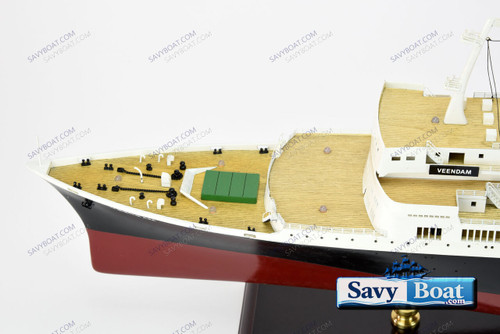
Now you can get this beautiful model in your own home or office. You can find many details of the model such as: All windows, doors, and portholes are cut out precisely thanks to hand-built hollow superstructure and hull; Open promenade decks visible through superstructure windows; Lattice grating on ducts and vents; Detail lifeboats hung from launching davits; Delicate railings on forecastle, aftcastle and top superstructure; Rigging and stay-lines on all masts and smokestacks. Furthermore, we applied multi-layered paint to match the color of the real ship.
Our master craftsmen handcraft these nicely detailed models from scratch using historical photographs, drawings and original plan. They are built to scale with top quality wood such as rosewood, teak, and mahogany. This replica is 100% handcrafted individually using plank-on-frame construction method and are similar to the building of the actual ship. She has been applied multi-layered paint to match the color of the real ship with highly-detailed such as: laser cut doors and window so you can see thru superstructure, thanks to a hollow hull and hollow superstructure. Each model requires hundreds of hours to finish and must go through a demanding quality control process before leaving the workshop. Due to te delicate nature of these models, small parts parts may dislodge during shipping and is not considered defective or cause for return. It’ll make a perfect gift for home or office decorator, boat enthusiast, or passionate collector. This replica is mounted on a solid wood base and ready to display.
NOW IS YOUR CHANCE TO OWN A PIECE OF MARITIME HISTORY!!!